

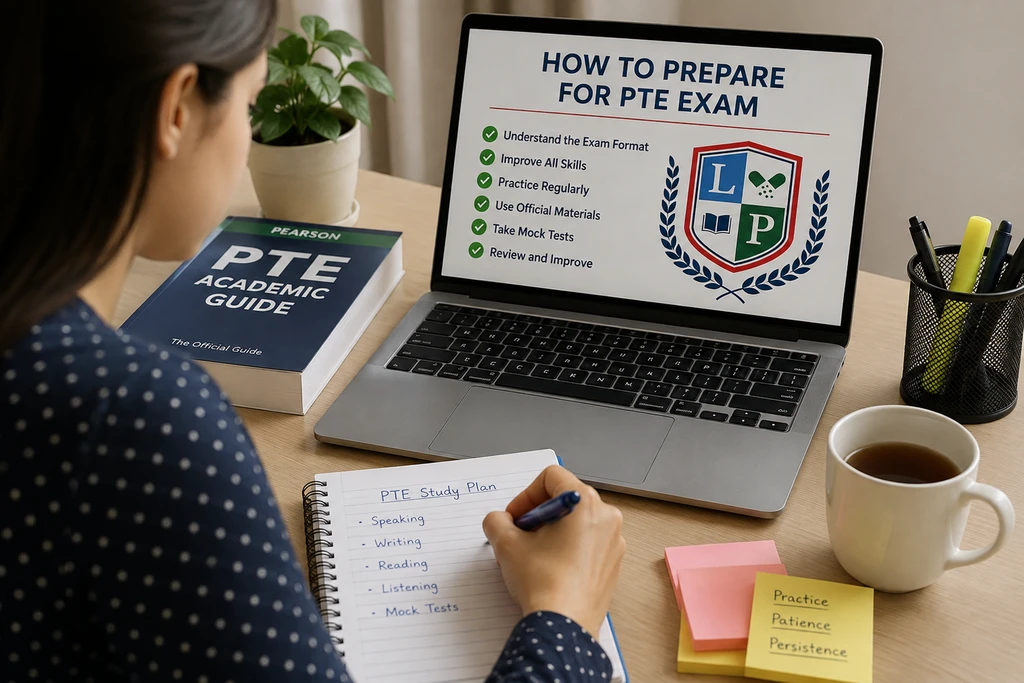
If you’re planning to study abroad, apply for skilled migration, or meet a healthcare registration requirement, chances are the Pearson Test of English (PTE) is standing between you and your next step. The good news? With the right PTE exam preparation guide and a structured plan, you can hit your target score without wasting months on guesswork.
This guide walks you through everything from understanding the exam format to building a week-by-week study plan so you know exactly how to prepare for PTE exam requirements the smart way. At Language Pills, we’ve coached 2,000+ learners through this exact process, so this guide reflects what actually moves the needle on test day, not just theory.
What Is PTE and Which Version Do You Need?
PTE isn’t just one test. Pearson offers several versions, and picking the right one matters before you even start preparing:
- PTE Academic – The most common version, accepted by universities, colleges, and immigration authorities worldwide for study and skilled migration.
- PTE Core – Designed specifically for Canadian immigration (Express Entry, PR, and citizenship applications).
- PTE UKVI – Used for UK visa and immigration purposes.
- PTE Express – A shorter version for institutions that only require a quick English proficiency check.
Before you start studying, confirm which version your university, employer, or immigration program actually requires the modules and scoring can vary slightly between them.
PTE Exam Format and Scoring: The Basics
PTE Academic is a fully computer-based, AI-scored test, which means your speaking, writing, reading, and listening are evaluated by an algorithm not a human examiner. That’s a big shift from tests like IELTS, and it changes how you should prepare.
The exam covers four core skills:
- Speaking – Tasks like Read Aloud, Repeat Sentence, Describe Image, Re-tell Lecture, Respond to Situation, and Summarize Group Discussion.
- Writing – Summarize Written Text and Essay, scored on grammar, vocabulary, structure, and written discourse.
- Listening – Summarize Spoken Text, Multiple Choice, Fill in the Blanks, Highlight Incorrect Words, Select Missing Word, and Write from Dictation.
- Reading – Reading & Writing Fill in the Blanks, Multiple Choice, and Re-order Paragraphs.
Because an AI is scoring you, clarity, pace, and correct pronunciation matter more than “sounding fancy.” Templates can help with structure, but over-relying on them without understanding why they work often costs candidates points.
Most test-takers aim for a target score of 65+, 79+, or 90, depending on the university or visa requirement, so know your number before you start studying, and build your plan around it.
How Long to Prepare for PTE: A Realistic Timeline
One of the most common questions candidates ask is how long PTE preparation actually takes. It depends on your starting English level and target score, but here’s a general framework:
How to Prepare for PTE Exam in 1 Month (Intensive Track)
Best if you already have strong English fundamentals and just need to learn the exam format.
- Week 1: Understand the exam pattern, question types, and scoring criteria. Take a diagnostic mock test.
- Week 2: Focus on Speaking and Writing these carry heavy weight and improve fastest with feedback.
- Week 3: Work on Listening and Reading strategies, timing, and accuracy.
- Week 4: Take full-length mock tests, review your score report, and fix weak areas before exam day.
6 – 8 Week Track (Recommended for Most Candidates)
If you’re starting from an intermediate level or have struggled with a previous attempt, spreading preparation over 6 – 8 weeks with live classes, structured feedback, and scored mock tests gives you time to actually fix weaknesses instead of just memorizing templates. This is exactly how the Language Pills PTE Preparation Course is structured: 4.5 weeks of live classes followed by 2 weeks of mock tests and performance analysis.
PTE Preparation Tips for Beginners
If you’re just starting out, these fundamentals will save you time and frustration:
- Take a diagnostic mock test first. You can’t fix what you haven’t measured. Know your baseline score before building a study plan.
- Don’t skip the tutorial questions. Many candidates lose easy points simply by not understanding how each question type is scored.
- Practice speaking out loud daily. The AI scoring engine rewards fluency and correct pronunciation. Silent reading won’t build this skill.
- Learn templates, but understand the logic. Templates help with structure, but content and coherence still matter.
- Time yourself on every practice task. PTE is a race against the clock, and poor time management is one of the top reasons scores fall short.
- Review your mock test score report properly. A detailed, module-wise breakdown tells you exactly where to focus next, don’t just look at the overall number.
Common Mistakes in PTE Speaking (and How to Avoid Them)
Speaking is where most candidates lose points unnecessarily. Watch out for:
- Speaking too fast or too slow – the AI engine expects a natural, steady pace.
- Long pauses or hesitation – these directly hurt your oral fluency score.
- Ignoring the microphone check – a poor recording can distort your entire response.
- Reading in a monotone voice – proper intonation and stress patterns affect your pronunciation score.
- Rushing through Describe Image without a structure – have a simple, repeatable framework for image and lecture-based tasks.
PTE Writing Templates for Essay: Use Them Wisely
Writing templates for the Essay and Summarize Written Text tasks are useful for structure introduction, body, and conclusion but examiners’ AI models are trained to detect generic, copy-paste answers. Use a template as a skeleton, not a script. Focus on:
- A clear thesis in your introduction
- Logical paragraph structure with linking words
- Varied vocabulary and sentence structures
- Correct grammar and word count (this is heavily penalized if ignored)
PTE Core vs PTE Academic: What’s the Difference?
If you’re applying for Canadian immigration, you’ll likely need PTE Core, not PTE Academic. The key differences:
- Purpose: PTE Core is built specifically for Canadian immigration pathways (Express Entry, PR). PTE Academic is more broadly used for university admissions and general migration worldwide.
- Content: PTE Core uses everyday, real-life contexts rather than academic material.
- Duration: PTE Core is shorter, around two hours.
Always double-check with your visa program or institution before choosing which test to prepare for, as preparing for the wrong version wastes valuable study time.
Self-Study vs PTE Online Course: Which Should You Choose?
Both routes can work, but they suit different candidates:
Self-study works well if:
- You have strong English fundamentals already
- You’re highly disciplined with a study schedule
- You just need format familiarity, not skill-building
A structured PTE preparation course works better if:
- You’re a repeat test-taker stuck at the same score
- You need personalized feedback on speaking and writing (which is hard to self-assess)
- You want scored mock tests with detailed, module-wise performance analysis
- You’re a working professional or student with limited time and need an efficient, guided path
This is where Language Pills fits in our PTE Preparation Course, which combines live coaching, AI-powered practice, and personalized feedback so you’re not left guessing where you stand.
PTE Preparation for Working Professionals
If you’re balancing a job with exam prep, efficiency matters more than volume. Focus on:
- Short, focused daily practice sessions (30–45 minutes) rather than occasional long sessions
- Live weekend or evening classes instead of self-paced content you might deprioritize
- Prioritizing high-weightage tasks (Speaking and Writing) when time is limited
- Booking a diagnostic consultation to identify exactly where your time is best spent
Frequently Asked Questions
How long should I prepare for PTE before booking my exam?
Most candidates need 4–8 weeks of consistent preparation, depending on their starting level and target score. Repeat test-takers stuck at a plateau often need more targeted, expert-guided practice rather than just more time.
What is a good target score in PTE?
It depends on your goal, many universities require 65+, while competitive programs and higher immigration points often require 79+ or even 90. Check your specific institution or visa program’s requirements before setting your target.
Can I prepare for PTE on my own without a course?
Yes, especially if your English fundamentals are already strong. However, self-assessing your own speaking and writing accurately is difficult, which is where structured feedback from trainers or a course makes the biggest difference.
What’s the best time to start PTE preparation before my exam date?
Ideally, start at least 6–8 weeks before your intended exam date. This gives you enough time to identify weak areas, get feedback, and take multiple scored mock tests before the real thing.
Ready to Stop Guessing and Start Scoring?
Understanding the format is only half the battle; the real score gains come from expert feedback, structured practice, and consistent mock testing. If you’d rather skip the trial-and-error and follow a proven, linguistics-based path to your target score, explore the Language Pills PTE Preparation Course, featuring live classes, AI-powered practice, and personalized feedback from PTE experts.
Book a free 30-minute PTE strategy call with Language Pills to get a realistic roadmap tailored to your target score no pressure, no cost.
